

Something fascinating is happening behind the scenes at the Emirates. While fans debate names and transfer fees on social media, Arsenal’s recruitment operation runs on spreadsheets, algorithms, and risk models that would feel more at home in a hedge fund than a football club. The data suggests that Arsenal’s 2026 summer business – five senior signings, three significant departures, and a squad publicly declared “set for the first half of 2026/27” – was anything but improvised. Every move reflected a calculated, profile-driven philosophy where analytics serves as the backbone of decision-making. So how exactly does this system work, and why has it become Arsenal’s quite competitive edge?
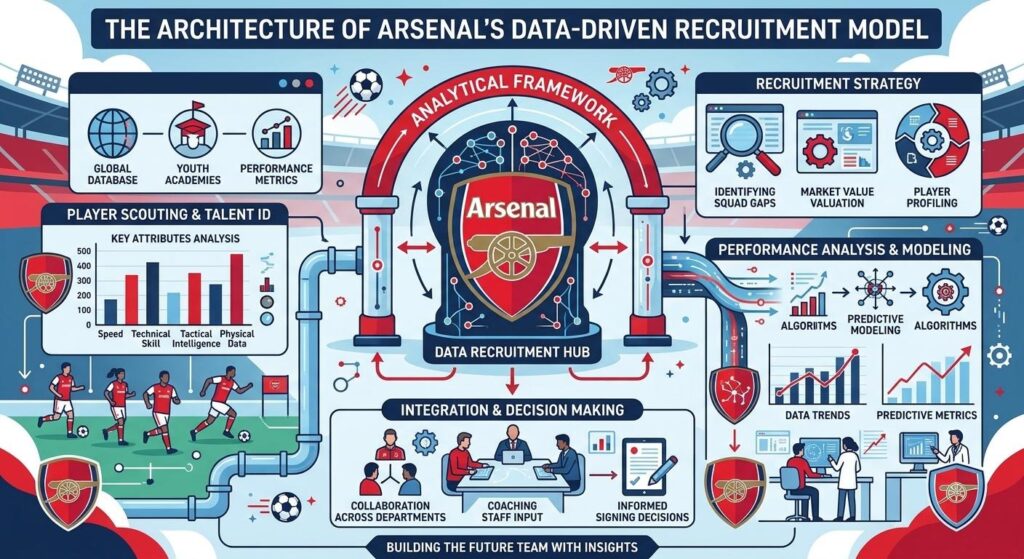
The Architecture of Arsenal’s Data-Driven Recruitment Model
Blending Analytics with Traditional Scouting
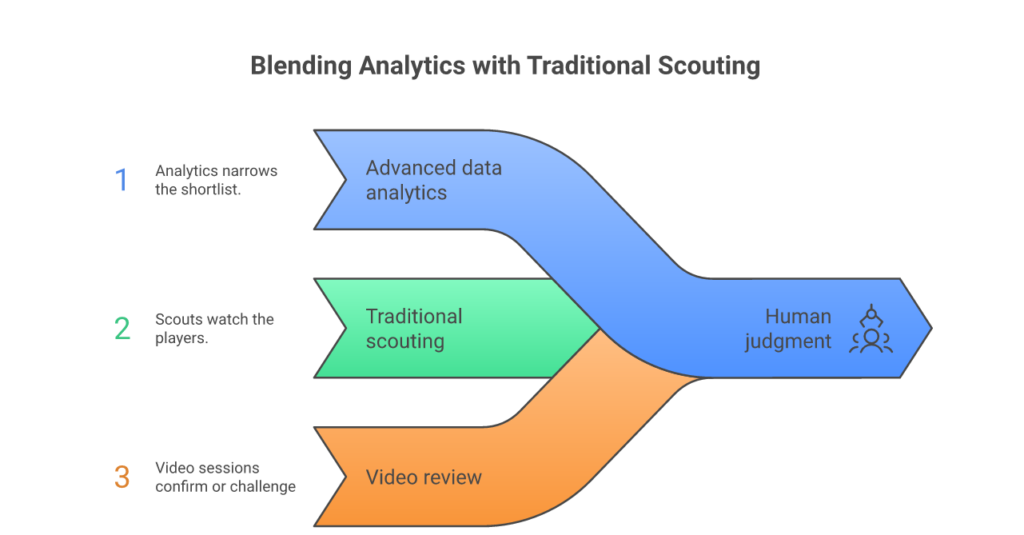
Arsenal’s recruitment model in 2026 isn’t some cold, automated machine spitting out names from a database. According to analysis from Arsenal-Mania, the club operates a blend of advanced data analytics, traditional scouting, and video review. Analytics narrows the shortlist. Scouts watch the players. Video sessions confirm or challenge what both the numbers and the eyes are saying. The key distinction here is that data doesn’t make the final call – it filters the noise so that human judgment gets applied to a smaller, higher-quality pool of candidates. Think of it like this: if traditional scouting is a fishing net, data analytics is the sonar that tells you where the fish actually are.
This layered approach matters enormously when you consider the sheer volume of available players. There are thousands of potential targets across Europe’s top leagues, second divisions, and emerging markets. Without data to screen for tactical fit, physical profile, injury history, and adaptation likelihood, scouting networks would drown in options. Arsenal’s system uses quantitative filters first, then qualitative evaluation second – a methodology that mirrors how algorithm-driven platforms in other regulated industries, from financial trading desks to https://automatenspielex.com/online-casinos/neue online entertainment platforms, use data models to surface optimal options from massive pools of possibilities. The result? Fewer wasted trips, fewer misidentified targets, and a recruitment pipeline that moves with genuine precision. Importantly, external data platforms like Sci Sports – which use Sci Skill ratings to rank and model player performance – are now actively referenced in transfer reporting around Arsenal targets. According to Football Transfers, players such as Kevin Shade were evaluated using these in-game performance data models, showing that external analytics ecosystems increasingly shape both internal decisions and public discourse.
What the Data Actually Measures
So what exactly are Arsenal’s analysts looking at? Research indicates three primary risk dimensions dominate their assessment framework. First, adaptation risk – the statistical likelihood that a player will maintain or improve performance when moving across leagues. Second, injury risk, which draws on workload history, muscle injury patterns, and minutes played relative to recovery windows. Third, tactical fit within Mikel Arteta’s system, which demands specific movement patterns, pressing triggers, and positional discipline that not every talented player can replicate.
Beyond on-pitch metrics, the data also informs market-value and resale-value decisions. Age profiles, contract timing, and future sell-on potential all feed into a financial model that sits alongside the football model. This dual-track approach – football suitability and financial viability assessed in parallel – is what separates a modern, analytics-integrated club from one that simply buys the best player it can afford. Arsenal’s 2026 transfer window demonstrated this clearly: every incoming signing checked multiple boxes simultaneously, and every departure served both squad-shaping and financial-regulatory purposes.
The 2026 Summer Window – A Case Study in Calculated Risk
Five Signings, One Clear Pattern
Look at who Arsenal actually brought in during summer 2026 and a pattern emerges immediately. Piero Hincapié arrived on a permanent deal. Allan Messier, Christos Tools, Bruno Guimarães, and Ezri Konsa followed. Three of those five – Guitars from Newcastle, Konya from Aston Villa, Messier from Leeds – were already playing in England. That’s not a coincidence. It’s a deliberate strategy rooted in adaptation-risk analytics. Players who already understand the pace, physicality, and tactical demands of English football represent lower integration risk. The data supports this approach, and Arsenal’s recruitment team clearly trusts it.
Here are the key facts and statistics that define Arsenal’s 2026 transfer strategy:
- Arsenal completed exactly 5 senior signings ahead of the 2026/27 season, per the club’s official transfer report
- 3 of those 5 signings were players already competing in English football, minimizing adaptation risk
- 3 notable senior departures occurred – Gabriel Martinelli, Gabriel Jesus, and Fabio Vieira – each serving dual squad and financial purposes
- The club declared its squad “set for the first half of 2026/27” as early as September 3rd, signaling front-loaded planning
- Arsenal face a confirmed sell-to-buy constraint heading into the January 2027 window, according to football.London reporting from November 2026
- UEFA’s Squad Cost Ratio rules were a binding factor in summer sales decisions, per The Athletic
- External Sci Skill-type data models were actively referenced in evaluating Arsenal transfer targets throughout the window
The departures tell an equally revealing story. Farinelli, Jesus, and Vieira weren’t simply players who fell out of favor. According to The Athletic, their sales were directly tied to reducing pressure under UEFA’s Squad Cost Ratio regulations. Arsenal were at risk of breaching these financial thresholds without substantial outgoings. The analytics team, then, wasn’t just identifying who to buy – it was modeling the financial consequences of keeping versus selling existing assets.
Comparing the Incomings and Outgoings
To appreciate the strategic balance Arsenal struck, consider this comparison of their summer 2026 activity:
| Category | Incoming Players | Outgoing Players |
| Number of moves | 5 senior signings | 3 notable senior sales |
| Primary purpose | Squad strengthening and tactical fit | Financial compliance and squad reshaping |
| Premier League experience | 3 of 5 had PL experience | All 3 had significant PL history |
| Risk profile | Lower adaptation risk (English league familiarity) | Declining output or limited tactical fit |
| Financial impact | Investment in targeted profiles | Revenue generation for UEFA SCR compliance |
What stands out is the symmetry. Arsenal didn’t simply spend. They restructured. Each departure funded and justified an arrival, and the entire operation was governed by financial regulations that are no longer background noise but, as 2026 reporting consistently shows, a frontline constraint. This is where risk assessment meets reality – you can identify the perfect transfer target, but if selling an existing player first isn’t financially viable, the deal doesn’t happen. Arsenal’s analytics infrastructure helps them model these interdependencies before committing to any single transaction.
Financial Regulations as a Strategic Variable
UEFA’s Squad Cost Ratio and Its Real Impact
Here’s something many fans underestimate: financial regulations now function as a genuine strategic variable, not just an accounting exercise. According to The Athletic’s September 2026 reporting, Arsenal were at risk of breaching UEFA’s Squad Cost Ratio rules without the summer sales they executed. The SCR operates alongside UEFA’s broader Football Earnings Rule, and together they create a binding framework that limits how much a club can spend relative to its revenue. For Arsenal, the sales of Farinelli, Jesus, and Vieira weren’t optional – they were necessary compliance mechanisms that simultaneously freed wage budget and generated transfer income.
This constraint hasn’t eased heading into winter. As of November 2026, football.London reports that Arsenal face a sell-to-buy reality for the January 2027 window. Internal complications require outgoings before any incoming moves can be financed. The data team’s role here is critical. Modeling which players can be sold, at what price, to which buyers, and with what wage savings allows Arsenal to identify the narrow window of financial possibility before the football decision even begins. Without that analytical infrastructure, the club would be operating blind in an increasingly regulated environment.
How Analytics Becomes a Competitive Advantage Under Constraints
Interestingly, tighter financial constraints might actually benefit clubs with sophisticated analytics operations. Why? Because when every pound matters more, the ability to identify undervalued players – those whose market price doesn’t reflect their true on-pitch contribution – becomes a genuine competitive edge. Arsenal’s profile-driven, opportunity-led approach to target identification is built for exactly this scenario. Rather than chasing marquee names with inflated price tags, the club anchors its shortlists to specific tactical, physical, and financial profiles. Statistics reveal that this methodology consistently surfaces players who fit the system at prices that satisfy regulatory requirements.
Consider the broader trend here. If UEFA financial constraints continue to tighten – and there’s no indication from 2026 data that they will loosen – clubs like Arsenal that front-load due diligence through analytics, medical screening, and video analysis will be able to move faster and more efficiently when market opportunities arise. Certainly, the January 2027 window will test this hypothesis. A modest, surgical approach – one or two targeted additions funded by departures – seems far more likely than any kind of spending spree, and that’s exactly the scenario where data-driven risk assessment pays for itself.
External Data Ecosystems and the Changing Transfer Landscape
The Rise of Public Analytics Platforms
Something worth noting is how external data models have started shaping not just internal club decisions but the entire transfer conversation. Platforms using Sci Skill-style ratings now feature prominently in media coverage of Arsenal targets. According to Football Transfers, targets like Kevin Shade were ranked and evaluated using these quantitative frameworks, and the resulting analysis influenced fan expectations, media narratives, and possibly even market dynamics. This creates a feedback loop: clubs use data internally, data platforms publish similar analysis externally, and the resulting public discourse can affect a player’s perceived market value before negotiations even begin.
For Arsenal, this means operating in a more transparent analytical environment than ever before. The advantage shifts from simply having data to having better data – proprietary models, deeper injury analytics, more granular tactical profiling – that public platforms can’t replicate. By the way, this is also why Arsenal’s centralized transfer activity tracker, which covers men’s, women’s, and academy teams for 2026/27, matters so much. It signals a structured, organization-wide approach to recruitment intelligence that goes well beyond what any external platform can capture.
Where This All Heads Next
The trajectory is clear. Arsenal’s transfer strategy in 2026 reflects a club that has fully embedded analytics into every layer of its recruitment process – from initial screening to financial modeling to regulatory compliance. The data doesn’t replace human judgment, but it elevates it. Scouts see fewer players but better ones. Decision-makers negotiate with more information. Financial planners model multiple scenarios before a single offer goes out. Indeed, the integration is so thorough that separating the “analytics decisions” from the “football decisions” has become almost impossible. They’re the same process now.
Going forward, expect Arsenal to continue prioritizing Premier League-ready profiles, operating within tight financial margins, and leveraging their analytical infrastructure to find value where less sophisticated operations see only risk. The January 2027 window will be a telling test – a constrained market environment where every decision carries amplified consequence. For Arsenal, that’s exactly the kind of environment where disciplined, data-informed risk assessment doesn’t just help. It defines whether the window succeeds or fails.
If you’re watching Arsenal’s next moves, don’t just look at the names. Look at the profiles, the prices, the regulatory context, and the risk models behind every decision. That’s where the real strategy lives – and in 2026, it’s powered by data more than ever before.