
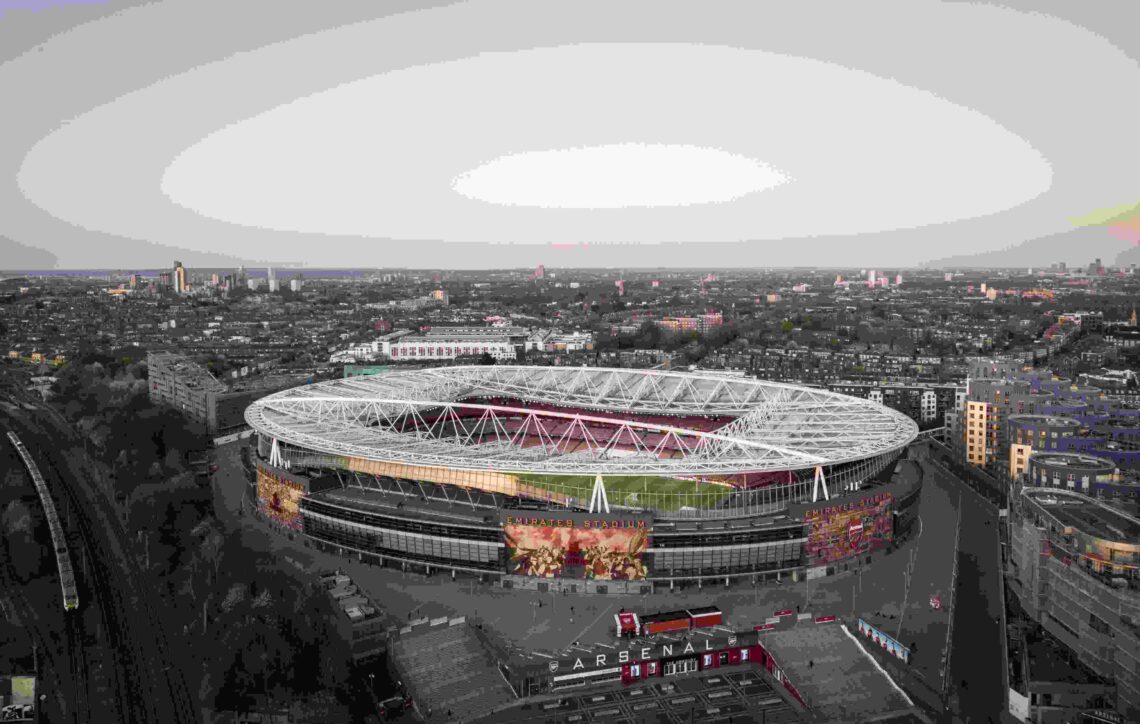

Arsenal’s current defence is beginning to enter some very familiar territory.
With Jurrien Timber, William Saliba, Gabriel Magalhães and Riccardo Calafiori forming Mikel Arteta’s preferred back four, the Gunners have arguably assembled the best defensive unit in the Premier League. Arsenal’s defensive strength was a major factor in their 2025/26 title-winning campaign, while their impressive start to 2026/27 has only strengthened the argument that they possess one of Europe’s most complete backlines.
But Arsenal have been here before.
For decades, the club has been blessed with outstanding defensive units, from George Graham’s famously stubborn back four to Arsène Wenger’s Invincibles. With insight from Lad Bet, we attempt to establish how the current Fab Four compare with two of the greatest defensive combinations in Arsenal history.
George Graham’s Famous Back Four
Lee Dixon, Tony Adams, Steve Bould and Nigel Winterburn
If Arsenal supporters were asked to name the club’s most iconic defensive unit, Graham’s back four would surely be near the top of the list.
Dixon, Adams, Bould and Winterburn became the foundation of Graham’s Arsenal during the late 1980s and 1990s. The quartet offered practically everything a defence could need: pace at full-back, physicality, positional discipline, leadership and an extraordinary understanding of one another.
Adams was the undisputed leader. The Arsenal captain was an imposing centre-back who combined aggression with excellent reading of the game, while Bould was perhaps the more understated member of the partnership but was equally important.
Dixon and Winterburn provided remarkable consistency from the full-back positions. Neither was renowned for being an ultra-attacking modern full-back, but both were exceptionally reliable defensively.
Their achievements underline just how good they were. The core of the back four helped Arsenal win the First Division title in 1988/89 and 1990/91, while further success followed under Wenger, including the 1997/98 double.
How do they compare with Arsenal’s current defence?
This is where the comparison becomes fascinating.
The modern Fab Four arguably have greater athleticism. Saliba is one of the Premier League’s quickest elite centre-backs, Timber possesses tremendous versatility and recovery speed, while Calafiori combines physical strength with the ability to carry the ball forward.
Gabriel, meanwhile, provides the aggression and physical presence that allows Saliba to operate alongside him.
However, Graham’s defence has one huge advantage: longevity.
Dixon, Adams, Bould and Winterburn played together through some of the most important years in Arsenal’s history. Their understanding was built over hundreds of matches, and they developed an almost telepathic knowledge of each other’s movements.
The current quartet have the potential to surpass them, but they cannot yet match their longevity or trophy haul.
Verdict: Graham’s back four edge it for now.
Wenger’s Invincibles
Lauren, Kolo Touré, Sol Campbell and Ashley Cole
If Graham’s defence represented discipline and defensive organisation, Wenger’s Invincibles brought those qualities together with incredible athleticism.
Lauren was a powerful and energetic right-back who could contribute at both ends of the pitch. On the opposite side, Ashley Cole was already establishing himself as arguably the finest left-back in England.
In the centre, Kolo Touré and Sol Campbell formed a formidable partnership.
Campbell provided experience, physicality and leadership, while Touré brought pace, aggression and the ability to defend huge spaces behind Arsenal’s high defensive line.
And the statistics from 2003/04 are remarkable.
Arsenal conceded just 26 goals in 38 Premier League games as they went the entire campaign unbeaten. They finished with 26 wins and 12 draws, becoming the first team to complete a 38-game Premier League season without defeat.
The back four were also supported by Jens Lehmann in goal and an extraordinary midfield shield featuring Patrick Vieira and Gilberto Silva.
That context is important.
The Invincibles were not simply four great defenders. They were part of an incredibly balanced team whose midfield and attack also helped Arsenal control matches.
Current Fab Four vs The Invincibles
This is probably the toughest comparison for the current defence.
Saliba and Gabriel have the potential to stand alongside Campbell and Touré. Saliba’s composure and ability to deal with attackers in one-on-one situations are particularly impressive, while Gabriel has developed into an aggressive and commanding centre-back.
At full-back, the comparison is slightly different.
Timber is arguably more technically versatile than Lauren, particularly in the modern inverted-full-back role, while Calafiori offers a combination of defensive strength and progressive passing that is perfectly suited to Arteta’s football.
But Cole remains a particularly difficult player to beat in this comparison.
At his peak, he was an exceptional one-on-one defender who could also contribute going forward. During the unbeaten 2003/04 campaign, Cole played 32 Premier League games and nine Champions League matches.
The current four may ultimately possess greater technical versatility, but the Invincibles have the defining achievement that makes them so difficult to surpass.
They didn’t just have an excellent defence.
They went an entire Premier League season without losing.
Verdict: The Invincibles still have the edge.
Where Does The 2026 Fab Four Rank?
The most encouraging thing for Arsenal supporters is that the current defence does not necessarily have to be better than those legendary units yet.
It simply has to keep progressing.
Arteta’s Arsenal have developed a defensive identity that is slightly different from both Graham’s and Wenger’s teams. They combine the physicality of the old-school Arsenal sides with the tactical flexibility demanded by modern football.
They can defend deep, press high, defend large spaces and build attacks from the back.
The current defence is also backed by an impressive collective structure. Arsenal’s defensive performance during 2025/26 was among the best in the club’s history, and their early 2026/27 performances have continued that trend.
Perhaps the biggest question is whether the Fab Four can build a legacy comparable to their predecessors.
Graham’s back four won major trophies and became synonymous with Arsenal’s defensive identity.
The Invincibles’ defence was part of perhaps the most famous season in the club’s history.
Timber, Saliba, Gabriel and Calafiori now have the opportunity to create their own chapter.
The Verdict
If we are judging legacy, Graham’s quartet and the Invincibles remain ahead.
If we are judging potential, however, Arsenal’s current Fab Four have every reason to believe they can eventually join them.
The modern game demands more from defenders than ever before, and Timber, Saliba, Gabriel and Calafiori possess the athleticism, technical quality and tactical intelligence required to thrive in it.
The key difference is that the previous two defences have already proved themselves over many years.
The 2026 quartet are still writing their story.
And if Arsenal continue to collect trophies while maintaining the defensive standards they have established, it may not be long before the question changes from “How do they compare?” to “Are they the best Arsenal back four of them all?”