
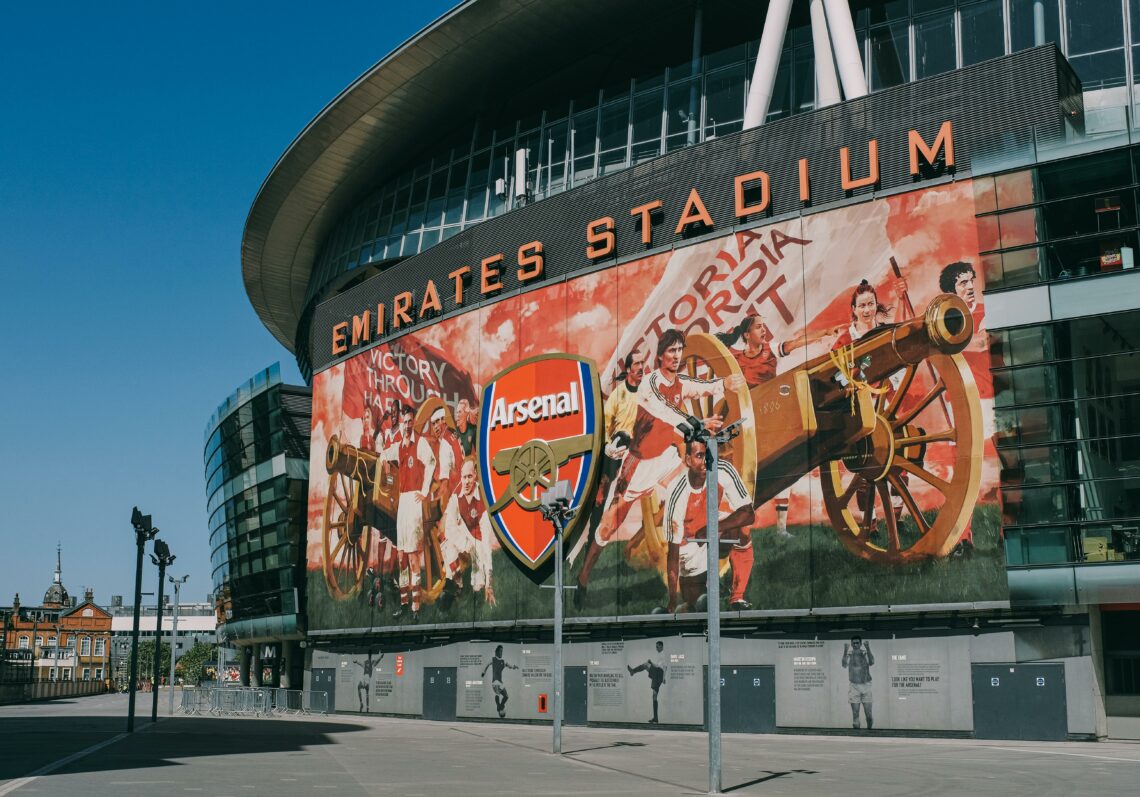

With the Premier League title secured and a transfer window about to open, Arsenal’s pursuit of Morgan Rogers and Nico Williams signals a club building not just to defend, but to dominate.
Three consecutive runners-up finishes can leave a club in one of two states: diminished or quietly furious. Arsenal chose the latter. The 2025-26 Premier League title, sealed with a game to spare as Manchester City drew at Bournemouth, was not just a release of tension. It was confirmation of a method, and Mikel Arteta is already focused on what comes next.
The window does not formally open until June 15, but the business has already started. Conversations are advanced, lists are drawn, and the names circulating around the Emirates are not speculative filler. Morgan Rogers of Aston Villa and Nico Williams of Athletic Club are the two players most consistently linked with north London moves, and the intelligence emerging from both camps suggests these are not idle pursuits.
For a club that spent £267m in the previous summer window and recouped very little, the question is not whether Arsenal will be active. It is how targeted and how expensive this particular rebuild will be.
The Left-Side Problem Arsenal Can No Longer Defer
According to The Athletic’s David Ornstein, the left-sided attack is Arsenal’s clearest priority this summer, a problem the club has been circling for several years without resolution. Gabriel Martinelli and Leandro Trossard have been reliable rather than exceptional, and Arteta needs a winger capable of unbalancing defences in the way that Bukayo Saka does from the right.
Williams represents the higher-risk, higher-reward option. The 23-year-old Spain international is currently preparing for the World Cup, and his performances at Euro 2024 remain the benchmark against which his recent club form is measured. A season disrupted by a pubalgic injury limited him to four goals and six assists in 26 appearances for Athletic Club, and that dip has complicated negotiations without entirely cooling interest. Athletic Club are understood to be willing to accept a fee in the region of £80 million, below the £95 million release clause in his contract, should a suitable offer arrive.
Rogers, by contrast, is the domestic option and arguably the more transformative one. The 23-year-old contributed 14 goals and 12 assists across all competitions for Aston Villa last season, making him one of the division’s most productive attacking midfielders. Arsenal, Manchester City, and Chelsea are all in pursuit, and Rogers himself has acknowledged the speculation, telling journalists at England’s World Cup training base in West Palm Beach that the interest is impossible to ignore while insisting his focus remains on the tournament.
What a Champions League Final Means for Recruitment
Arsenal’s season did not end with the Premier League trophy. The club reached the Champions League final in Budapest, where they faced holders Paris Saint-Germain, completing a campaign that placed them firmly back in European football’s highest tier. Arteta, who won the Premier League Manager of the Season award after posting 27 wins and seven draws from 38 league games, has maintained throughout that the title was a platform, not an endpoint.
The financial confidence attached to a title-winning campaign has altered the club’s leverage in negotiations. One analyst, speaking to Casinos.com, a widely read independent resource for online casino guidance, offered a wider perspective on how momentum in any sector shifts when results accumulate. “When you are a champion, your position in every conversation changes,” the analyst noted. “The party that wants something from you has to adjust their terms.” Arsenal’s sporting director Andrea Berta, who handled transfers at Atletico Madrid before arriving in north London, understands that dynamic as well as anyone.
Viktor Gyokeres, Arsenal’s top scorer with 21 goals across all competitions, demonstrated the effectiveness of a central striker who presses with purpose and runs beyond defences. The question Arteta must now answer is who provides the creative spark from the left that elevates the attack from very good to exceptional.
Rogers, Williams, or Both: The Shape of Arteta’s Next Squad
It would be premature to characterise this window as a choice between Rogers and Williams. Arsenal’s documented interest in both players, combined with Ornstein’s suggestion that total spend this summer could match the £267m laid out twelve months ago, points to a club capable of pursuing more than one marquee addition.
The implications of either arrival are significant. Williams is a wide forward whose pace and dribbling are most effective in one-versus-one situations on the touchline. His data from the 2023-24 season, when he produced 17 assists in 37 appearances, suggests he operates at a level the current Arsenal attack has not consistently reached from the left. Rogers is a different profile: technically precise, capable of cutting inside and making runs in behind, and productive enough at set pieces to complement the club’s record of 19 corner-kick goals last season.
One observer with knowledge of the situation said: “Arteta’s front line covered more ground per game than any side in the Premier League’s top five over the last ten matches of the season. The question with Rogers is whether he can maintain that output at a club with a different defensive demand, one that asks wingers to press as much as they create.” The suggestion from those within the club is that the answer is yes, but a medical and a conversation about role will determine the final decision.
The Exits Funding the Ambition
Any summer of major incomings requires movement in the other direction. Leandro Trossard and Oleksandr Zinchenko are among the players whose contracts expire this summer, reducing the wage bill, while Jakub Kiwior’s loan to Porto is set to become permanent. The departure of Trossard in particular would signal clearly that Williams or Rogers has been acquired to fill the left-wing role on a more permanent basis.
There are also structural questions around the midfield and right-back positions. The Premier League title was built on a defensive record that allowed only 27 goals all season, with David Raya claiming the Golden Glove for the third successive year. Preserving that structure while adding offensive quality is the challenge every successful manager faces when the foundation is already excellent.
Arteta addressed the question at the end of the season with characteristic directness: “The demand at this club does not get smaller when you win. It gets bigger, because now everyone knows what we are capable of.”
The summer that follows a title season is always revealing. It shows whether a club treats success as a destination or a departure point. Arsenal’s pursuit of Rogers and Williams, combined with a willingness to spend at scale for a second consecutive year, suggests Arteta sees 2025-26 not as the summit but as the first foothold.