Arsenal Trophies: Every honour won, full list (updated 2026)
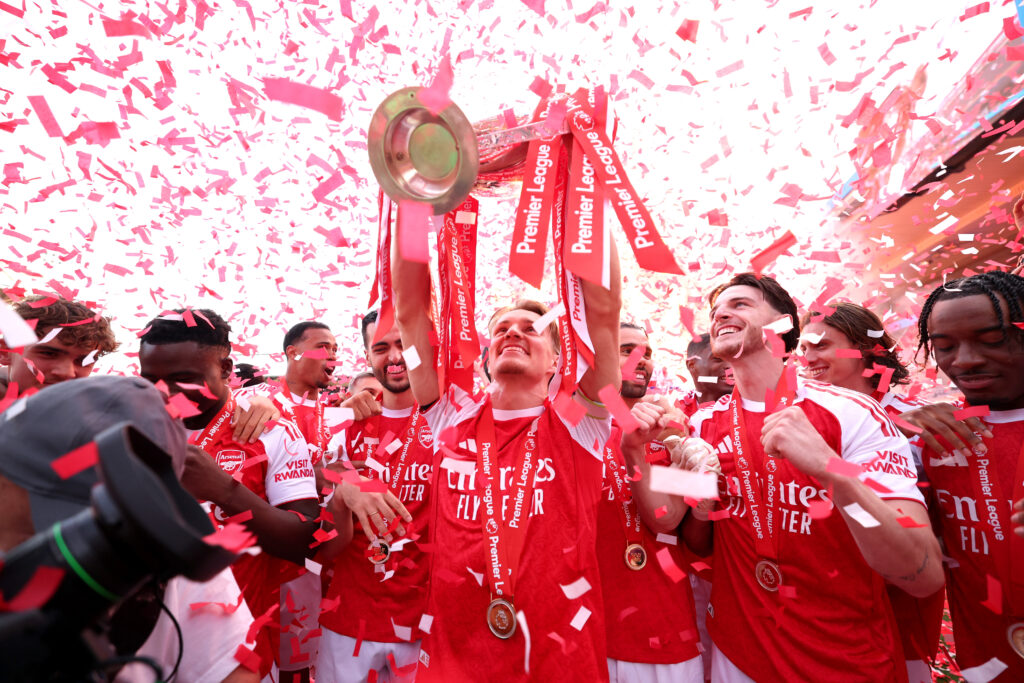
Arsenal are one of the most decorated clubs in English football. The men’s first team have won 14 English league titles, a record 14 FA Cups, two League Cups, 18 FA Community Shields and two European trophies.
Arsenal Women are the most successful side in the history of English women’s football, and the only English club to have won the UEFA Women’s Champions League.
This page lists every honour won by the men’s first team, the women’s team and the academy, with the season each was won.
It is updated after every trophy.
Last updated: 19 September 2026.
The short answer
| Question | Answer |
|---|---|
| Arsenal’s most recent trophy | 2026 FA Community Shield, beating Manchester City 3-0 on 16 August 2026 |
| Arsenal’s most recent league title | 2025/26, their 14th English title and fourth of the Premier League era |
| Arsenal’s most recent FA Cup | 2019/20 |
| League titles | 14 |
| FA Cups | 14, more than any other club |
| League Cups | 2 |
| FA Community Shields | 18, one of them shared |
| European trophies | 2 |
| Champions League titles | None. Runners-up in 2006 and 2026 |
Arsenal men’s first team honours
League titles (14)
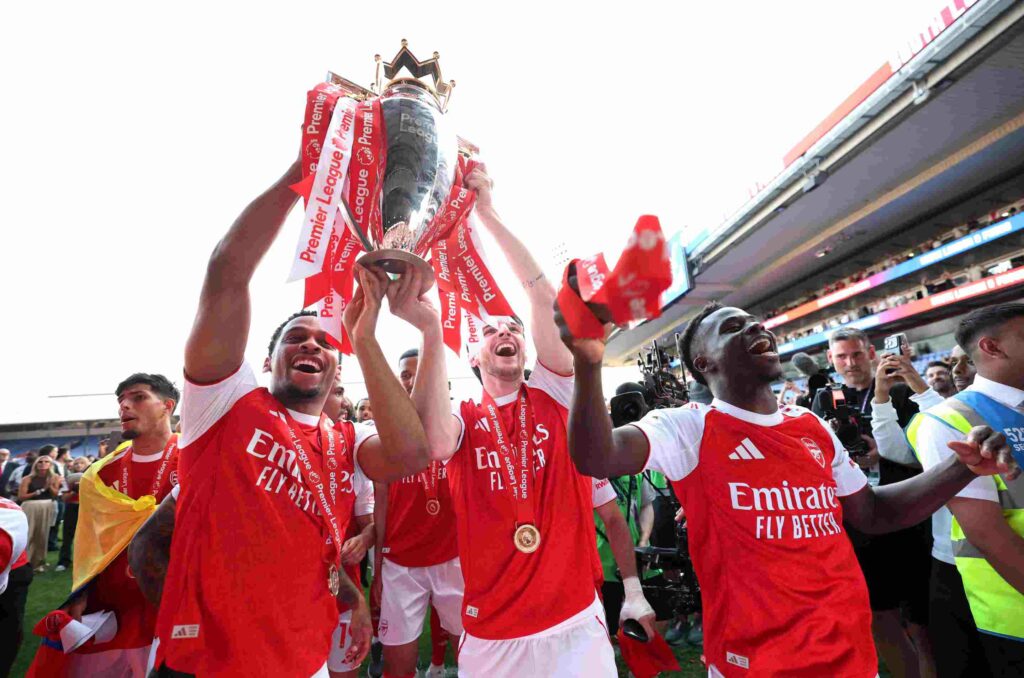
Arsenal have been champions of England 14 times, four of them in the Premier League era.
1930/31, 1932/33, 1933/34, 1934/35, 1937/38, 1947/48, 1952/53, 1970/71, 1988/89, 1990/91, 1997/98, 2001/02, 2003/04, 2025/26.
The 2003/04 title was won without losing a single league match, the only 38-game unbeaten top-flight season in English football history, and the side became known as the Invincibles.
Their unbeaten league run stretched to 49 matches between 7 May 2003 and 24 October 2004, a national record.
Only Preston North End, over a 22-game season in 1888/89, had previously gone a full top-flight campaign unbeaten.
The 2025/26 title was Arsenal’s first in 22 years and the first under Mikel Arteta.
It was secured on 19 May 2026 with a game to spare, when Manchester City drew 1-1 at Bournemouth the day after Arsenal had beaten Burnley 1-0 at the Emirates.
Arsenal finished on 85 points from 38 games, winning 26, drawing seven and losing five, with 71 goals scored and 27 conceded, and lifted the trophy after a 2-1 win at Crystal Palace on the final day.
FA Cup (14)
No club has won the FA Cup more often than Arsenal.
1929/30, 1935/36, 1949/50, 1970/71, 1978/79, 1992/93, 1997/98, 2001/02, 2002/03, 2004/05, 2013/14, 2014/15, 2016/17, 2019/20.
League Cup (2)
1986/87, 1992/93.
Arsenal have reached the final on several further occasions, most recently in 2026, when they lost 2-0 to Manchester City at Wembley on 22 March.
FA Community Shield (18)
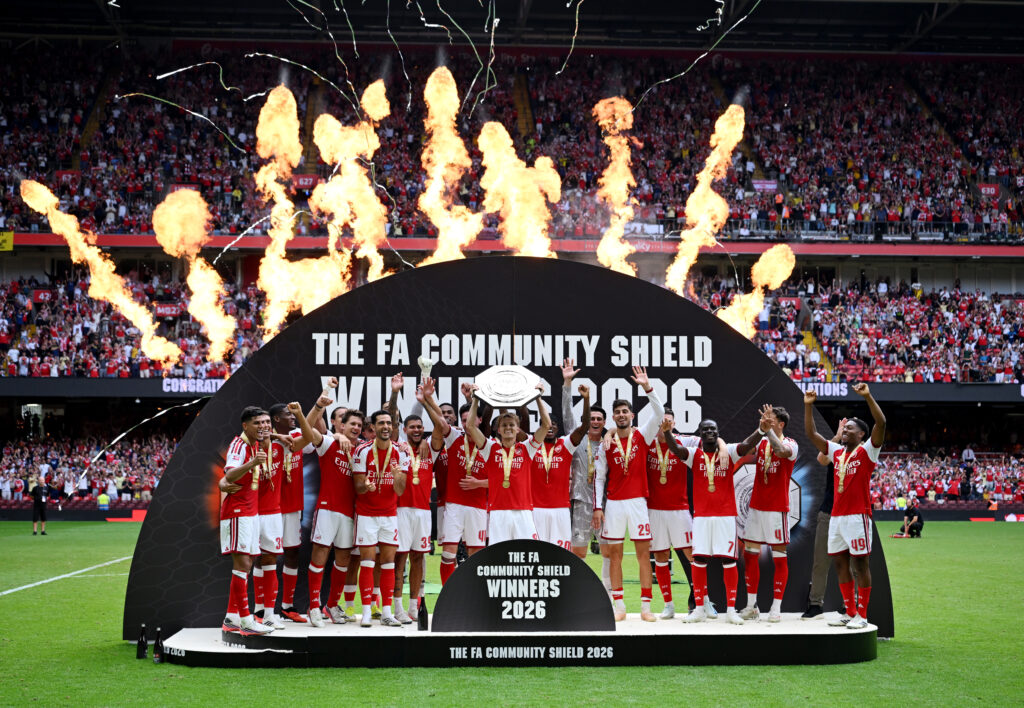
1930, 1931, 1933, 1934, 1938, 1948, 1953, 1991 (shared), 1998, 1999, 2002, 2004, 2014, 2015, 2017, 2020, 2023, 2026.
The most recent came on 16 August 2026 at the Principality Stadium in Cardiff, where Arsenal beat Manchester City 3-0 in front of 58,056 supporters.
Riccardo Calafiori scored inside the opening minute after a through ball from Myles Lewis-Skelly, Kai Havertz headed in the second on 28 minutes, and Martin Ødegaard, named man of the match, made it three three minutes into the second half.
Football League Centenary Trophy (1)
1988.
Doubles
Arsenal have won the league title and the FA Cup in the same season three times: 1970/71, 1997/98 and 2001/02.
Arsenal in Europe
European trophies won (2)
| Competition | Season | Final |
|---|---|---|
| European Cup Winners’ Cup | 1993/94 | Beat Parma 1-0 in Copenhagen on 4 May 1994, Alan Smith scoring on 20 minutes |
| Inter-Cities Fairs Cup | 1969/70 | Beat Anderlecht 4-3 on aggregate, losing the first leg 3-1 in Brussels before winning 3-0 at Highbury on 28 April 1970 through Eddie Kelly, John Radford and Jon Sammels |
European finals lost (4)
| Competition | Season | Result |
|---|---|---|
| UEFA Cup | 1999/2000 | Drew 0-0 with Galatasaray in Copenhagen, lost 4-1 on penalties |
| Champions League | 2005/06 | Lost 2-1 to Barcelona |
| Europa League | 2018/19 | Lost 4-1 to Chelsea in Baku, Alex Iwobi scoring |
| Champions League | 2025/26 | Drew 1-1 with Paris Saint-Germain at the Puskás Aréna in Budapest on 30 May 2026, lost 4-3 on penalties |
Arsenal have therefore never won the European Cup or Champions League, and never won the UEFA Cup or Europa League.
Arsenal Women honours

Arsenal Women are the most decorated club in English women’s football. The club’s official honours list records 63 trophies, to which the 2026 FIFA Women’s Champions Cup has since been added.
FIFA Women’s Champions Cup (1)
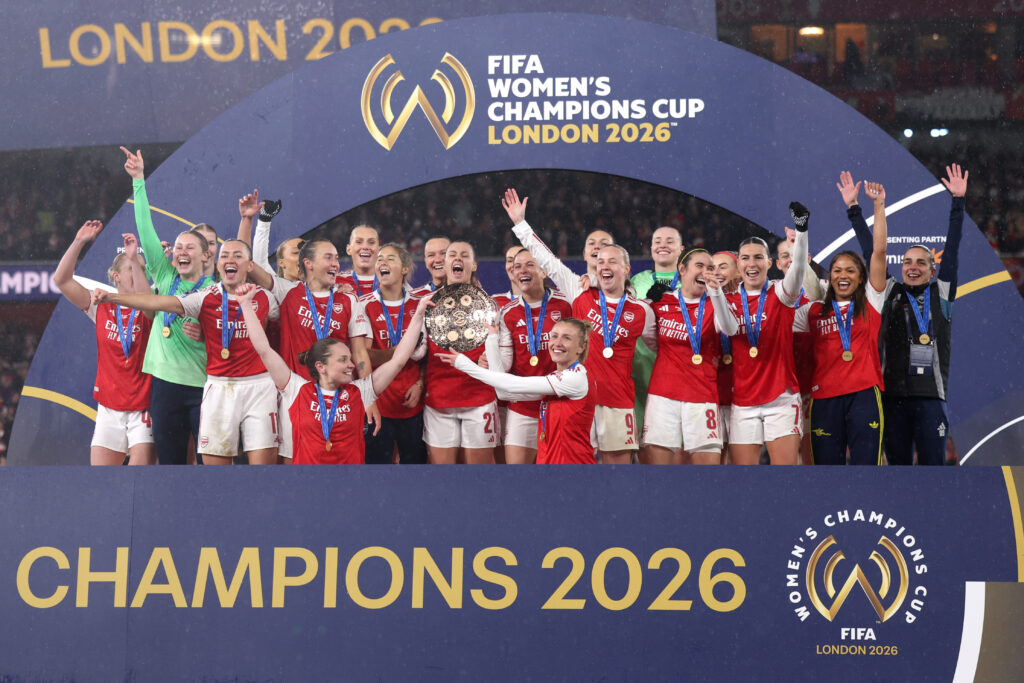
2026. Arsenal beat Corinthians 3-2 after extra time at the Emirates Stadium on 1 February 2026 to become the inaugural winners of the competition. Olivia Smith opened the scoring on 15 minutes, Lotte Wubben-Moy restored the lead on 58, and Caitlin Foord settled it on 104 minutes after Victória had equalised from the penalty spot in the sixth minute of stoppage time. Alessia Russo and Smith finished as joint top scorers in the tournament.
UEFA Women’s Champions League (2)
2006/07, beating Umeå IK 1-0 on aggregate. 2024/25, beating Barcelona 1-0.
Arsenal remain the only English club to have won the competition.
FA Women’s Super League (3)
2011, 2012, 2018/19.
FA Women’s Premier League (12)
1992/93, 1994/95, 1996/97, 2000/01, 2001/02, 2003/04, 2004/05, 2005/06, 2006/07, 2007/08, 2008/09, 2009/10.
Women’s FA Cup (14)
1992/93, 1994/95, 1997/98, 1998/99, 2000/01, 2003/04, 2005/06, 2006/07, 2007/08, 2008/09, 2010/11, 2012/13, 2013/14, 2015/16.
FA Women’s League Cup (7)
2011, 2012, 2013, 2015, 2017/18, 2022/23, 2023/24.
FA Women’s Premier League Cup (10)
1991/92, 1992/93, 1993/94, 1997/98, 1998/99, 1999/2000, 2000/01, 2004/05, 2006/07, 2008/09.
FA Women’s Community Shield (4, plus 1 shared)
1999/2000 (shared, after a 1-1 draw with Charlton Athletic), 2001/02, 2005/06, 2006/07, 2007/08.
London County FA Women’s Cup (10)
1994/95, 1995/96, 1996/97, 1999/2000, 2003/04, 2006/07, 2007/08, 2008/09, 2009/10, 2010/11.
Arsenal academy honours
The club’s academy teams have won 18 trophies.
FA Youth Cup (7)
1966, 1971, 1988, 1994, 2000, 2001, 2009.
Arsenal are the third most successful club in the competition’s history.
Other academy honours
| Competition | Total | Years |
|---|---|---|
| Premier League 2 | 1 | 2017/18 |
| Premier Academy League | 1 | 1998/99 |
| Southern Junior Cup | 5 | 1956, 1971, 1984, 1991, 1998 |
| FA U19 National Academy Play-Off Final | 1 | 2002 |
| FA U18 National Academy Play-Off Final | 1 | 2009/10 |
| FA U17 National Academy Play-Off Final | 1 | 2000 |
| South East Counties League | 1 | 1991 |
Sources
- Arsenal Women’s honours, Arsenal.com
- Academy honours, Arsenal.com
- Men’s honours and year lists, List of Arsenal F.C. records and statistics, Wikipedia
- 2025/26 Premier League final table and title details, 2025–26 Premier League, Wikipedia and Premier League
- 2026 FA Community Shield, The FA and 2026 FA Community Shield, Wikipedia
- 2026 EFL Cup final, List of EFL Cup finals, Wikipedia
- 2026 Champions League final, 2025–26 UEFA Champions League, Wikipedia
- 2026 FIFA Women’s Champions Cup final, 2026 FIFA Women’s Champions Cup final, Wikipedia
- European finals, Wikipedia pages for the 1970 Inter-Cities Fairs Cup final, 1994 European Cup Winners’ Cup final, 2000 UEFA Cup final and 2019 UEFA Europa League final
Arsenal’s 5 greatest wins at Wembley
1929/30 FA Cup final – Huddersfield Town, 2-0
In 1930, Alex James and Jack Lambert scored as Arsenal won their first ever major trophy in their first match at Wembley. It was also the first time the BBC ever paid for the rights to broadcast a match.
Three years earlier, the Gunners disappointingly lost their first final, 1-0 against Cardiff City. The match gave them the chance to put things right, under legendary manager Herbert Chapman. Tom Parker captained the side to victory and set Arsenal on the way to the record 14 FA Cups they hold today.
1970/71 FA Cup final – Liverpool, 2-1
Arsenal won the 1971 final in dramatic fashion, coming from behind to beat Liverpool in extra time. The Gunners were trying to complete a league and cup double, after winning the title at White Hart Lane. They had to beat Liverpool to do so though, in front of 100,000 fans.
After 90 minutes, the game remained 0-0, with both teams struggling to get control of the match. Liverpool quickly took the lead in extra-time, and almost made it 2-0 when Bob Wilson was called into action. Fortunately, Eddie Kelly scored the equaliser to keep the Gunners alive. He was the first substitute ever to score in an FA Cup final.
Then Charlie George added a second with minutes to go, and followed the goal up with his famous celebration, lying on his back. Arsenal completed their double winning season and were cheered off the pitch by both sets of fans.
1978/79 FA Cup final – Manchester United, 3-2
Arsenal’s first match at Wembley against Manchester United contained even more late drama. The Gunners went into the final five minutes of the 90 minutes 2-0 up, thanks to earlier goals from Brian Talbot and Frank Stapleton.
United then pulled it back through and 86th minute goal from Gordon McQueen and an 88th minute effort from Sammy McIlroy.
Just as the match looked to be heading to extra time, Alan Sunderland scored in the 89th minute to win the cup for Arsenal. The match is now more commonly known as the ‘five minute final’.
2013/14 FA Cup final – Hull City, 3-2
Arsenal’s first cup final win at the new Wembley involved a comeback from 2-0 down to end a 9-year trophy drought. With a Champions League final loss and a number of faltering title challenges, the Gunners had gone year-after-year without winning anything, despite a number of talented teams.
During that time, Arsenal lost both their matches at the new national stadium. Fortunately, the Gunners ended that losing run by beating Wigan Athletic on penalties. They’d need to go one further to end the drought, and faced underdogs Hull City.
It should’ve been a walkover, but instead the team crumbled in the first 10 minutes. Hull raced into a 2-0 lead, and honestly should’ve been three up before Arsenal remembered there was a game on. Santi Cazorla’s free-kick brought the tie back to life, before Laurent Koscielny levelled things up in the second half.
Aaron Ramsey won the match in extra-time, sparking celebrations expressing equal amounts of joy and relief from players, manager and fans.
2016/17 FA Cup final – Chelsea, 2-1
A few years later, Arsenal returned under entirely different circumstances. This time, the Gunners were the underdogs, facing the Premier League champions and London rivals, Chelsea. Every pundit and expert around seemed to think the Blues would walk the match.
Instead, Arsenal took a shock lead through Alexis Sanchez. Chelsea responded in the second half through Diego Costa, but Aaron Ramsey was on hand again to restore the lead. The true heroes were the Gunners’ defence. Laurent Koscielny got himself banned the previous week, so Nacho Monreal, Per Mertesacker and Rob Holding had to combine in a makeshift back-three.
The trio did their job admirably, showing fight and determination to shut their opponents down. Costa needed a deflection to finally breach their resistance, and even then it wasn’t enough. It might not have been the most exciting final ever, but for me it was one of the most satisfying.
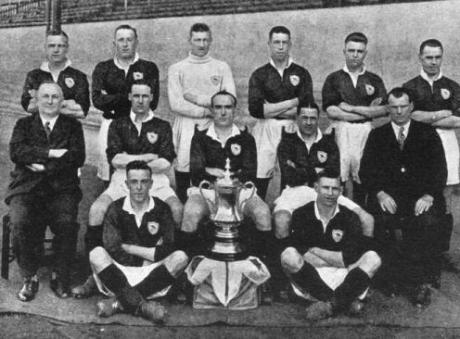
1930: Arsenal’s first FA Cup final win
Today, largely thanks to Arsène Wenger’s influence, Arsenal are FA Cups kings with 14 in their trophy cabinet but Arsenal’s first FA Cup came 90 years ago, at the end of the 1929/30 season.
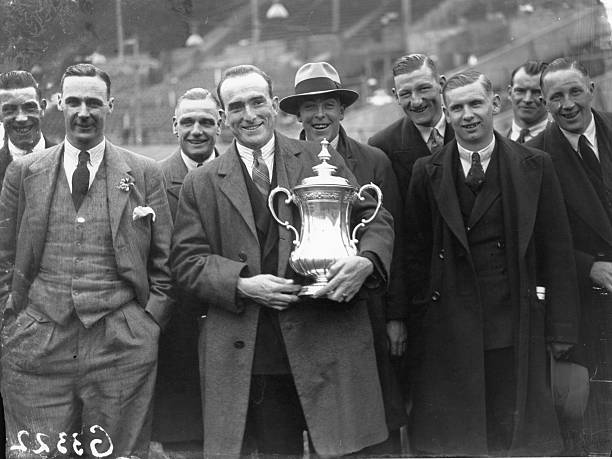
At the time, the Gunners had been around for over 40 years, but were still yet to win their first major trophy. However, the club had been edging closer in the cup over the previous few years.
In the league, Arsenal weren’t doing anything particularly exciting, finishing 11th, 10th and 9th in the three seasons prior to 1929/30. But just like in recent seasons today, the FA Cup was bringing something extra out of the side, and they’d finished as runners-up, semi-finalists and quarter-finalists.
But they still needed to go that one step further and win the competition, to really write their name in the history books, and take that extra step forward as a club.
Just as it is today, the Gunners didn’t enter the tournament until the third round proper.
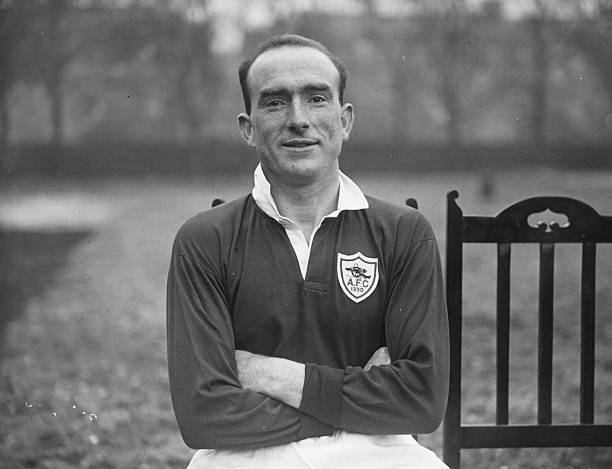
Before that there were two preliminary rounds, four qualifying rounds and of course the first two rounds proper, all of which culminated in 20 lower-league teams being added to the mix. They would be joined by 22 teams from the second division and 22 from the first.
Arsenal drew one of those teams from the second division, Chelsea.
Nonetheless, the match drew a fair crowd with over 55,000 fans turning up to watch the game at Highbury. The Gunners won 2-0, courtesy of goals from Jack Lambert and Cliff Bastin and it was onto the next round.
The fourth round brought a tougher test, in Birmingham City. Birmingham were one of Arsenal’s mid-table rivals in the first division at the time, so they were likely to put up more of a fight than Chelsea in the first round. So it proved, as Cliff Bastin scored again along with David Jack, but the Gunners were held to a 2-2 draw, forcing a replay away from home.
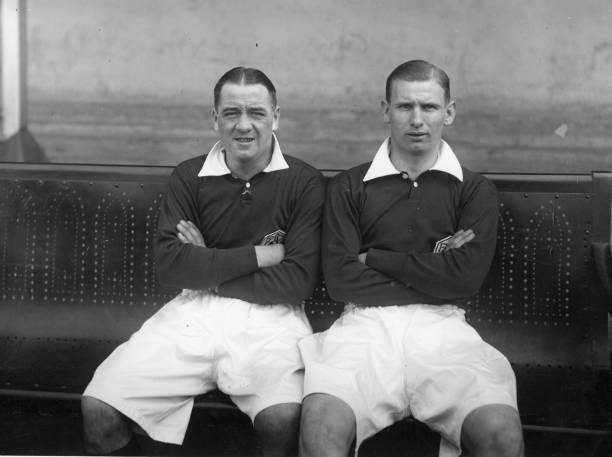
The replay wasn’t much more straight-forward, and it took a penalty from Alf Baker to separate the two sides, as Arsenal eventually triumphed 1-0.
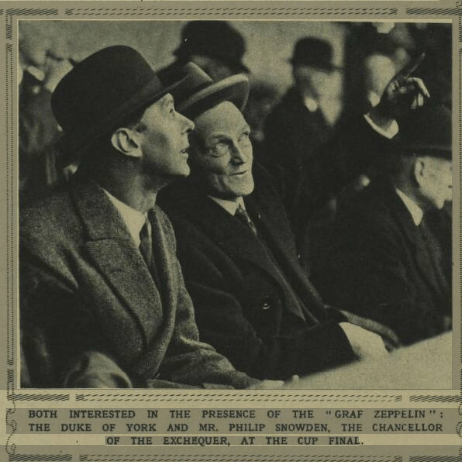
Now in February, Herbert Chapman’s side prepared for their fifth round match against recently promoted Middlesbrough. The Boro had finished top of the second division the previous season, and were holding their own in the country’s top league.
Arsenal had to travel to the North-East for the match at Ayresome Park, but ended up with another comfortable win. It was a repeat of the opening round, with the same scoreline (2-0) and goalscorers, Lambert and Bastin.
Bastin in particular was making a name for himself with goals in every round so far.
But against high-flying West Ham at Upton Park, it was Lambert and Baker who kept their tallies growing, with two from Jack and one from Alf to walk away 3-0 winners. On paper this should’ve been the hardest tie so far, but Arsenal were on a roll and moved onto the semi-finals with ease.
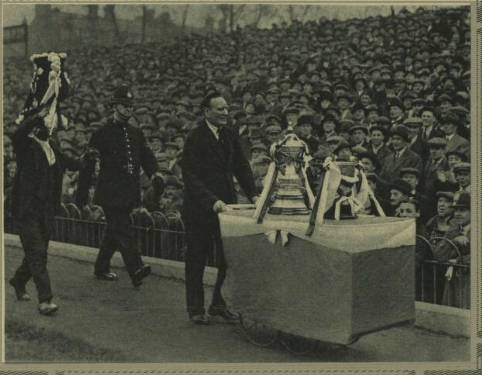
The Gunners drew Hull in the semis, to be played at the neutral venue of Elland Road in Leeds. For the fourth time in six matches, the team scored twice, thanks to David Jack and Cliff Bastin, but it ended in a draw. Back then, a draw in an FA Cup semi-final meant a replay, rather than extra time, so four days later it was off to Villa Park for the rematch.
David Jack got on the score-sheet again in a 1-0 win, and sent the club to their second final in four years.
So. on 26th April 1930, Arsenal faced Huddersfield Town in front of 92,488 fans at Wembley.
Goalscorers in the previous rounds Alf Baker, David Jack, Jack Lambert and Cliff Bastin all made the team for the final, but it was the team’s creative genius who ended up breaking the deadlock on the day.
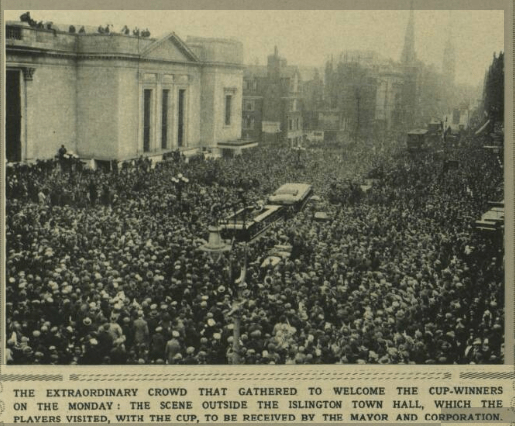
Alex James had been signed up by Herbert Chapman at the start of that season, but after a slow start he’d begun to impress fans with his ball control and passing abilities. On this occasion he turned goalscorer, playing a one-two with Bastin before firing into the net from range.
He was back to providing the goals before long, as a long pass found Jack Lambert to add a second and secure Arsenal’s first FA Cup victory, and first major trophy.
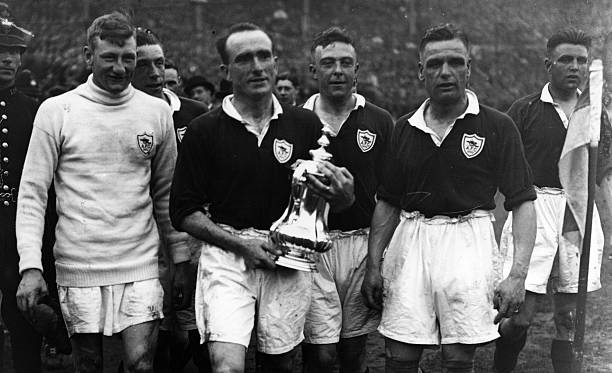
The Gunners stayed at Wembley celebrating until even the crowd had gone home, and it was a major turning point in the history of the club, considering the successes to come in the 1930s.